| HOME | ||
 |
|
JACK GAGLIARDI, Homeopath, Hom, DSHomMed, RCSHom,
Registered Homeopath with (416) 832-3448
jack@homeopathyheals.com
APPOINTMENTS
WHAT IS HOMEOPATHY?
Live Blood Cell Analysis |
Homeopathic Medical Philosophy
Homeopathic medicine is a 200+-year-old system of medicine that utilizes specially prepared minimal doses of medicines made from various substances of the plant, mineral or animal kingdom. Each medicine is prescribed for its capacity to cause, if given in overdose to healthy people, symptoms similar to those that the sick person is experiencing. Because basic physiology recognizes that symptoms represent defenses of the body (and mind) in its efforts to fight infection and/or adapt to stress, a safe homeopathic medicine is selected for its capacity to mimic a person's own symptoms, thereby augmenting their own defensive response. Homeopathic remedies work by stimulating the body's own ability to heal. You might think of a remedy as a bit of information - a trigger that sets the body's inherent ability to heal into action using its self-defense and self-regulating mechanisms. Many ailments, such as the common cold, can cure themselves over time, but in more chronic diseases, the body requires assistance. In homeopathy, this assistance is provided by way of a Homeopathic remedy to provide the stimulus your body needs to set the curative process into action. With the correctly prescribed homeopathic remedy, your body is allowed to be returned to a more normal state of functioning - naturally, safely and with no side effects.
Healing occurs by addressing imbalances in the individual that have led the patient to a diseased state. Homeopathic medicine was founded on one law of nature, that being the law of Similars or "like cures like". This law states that substances which are capable of producing specific symptoms when consumed in repetitive doses by a healthy individual are also capable of treating a "similar" set of symptoms, the result of disease, in a sick person. The word homeopathy reflects this law, being derived from two Greek words, "homeo" meaning similar and "pathos" meaning suffering. In homeopathy, minute potentized doses of natural substances are used to stimulate the body's own natural ability to heal itself. In any case of disease a prescription is based on the totality of symptoms expressed by the patient ie., physical, mental and emotional. A single remedy, exhibiting similar symptoms, is then introduced to the body which then triggers and initiates the healing process.
Symptoms produced by a patient are not the "disease", as seen
in traditional or allopathic medicine. Instead, they are viewed
as a visual, external expression of the body's own imbalance and
its own attempt at cure. In homeopathy, "disease" in terms of
specific pathology is not treated directly. Instead, it is the
fundamental "imbalance" that is seen to exist in the patient;
as defined by the patient's symptoms, that is therefore addressed.
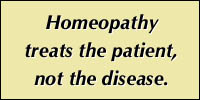
It is sometimes said that homeopathy treats the patient, not the
disease. No Side Effects ... No Suppression Homeopathy encourages the body to continue healing in a way similar to its own initial reaction to the disturbance (nature's response is seen to be the best response). In this way, the individual's own attempts at cure are honoured and not subdued. Side effects, as often noted in other types of medicine, are not an issue as homeopathy only stimulates the body's own natural attempts at cure. Classical homeopathy (which is what I primarily practice) means that only one homeopathic medicine is given at a time because only one homeopathic medicine can correspond to the total picture of the patient. A prescription that does not aim for this totality is not homeopathic. Your homeopath may change the prescription over time. As the presenting symptoms change, so can the medicine given. By analogy, in homeopathic philosophy, cases present themselves somewhat like the layers of an onion, each with their own set of symptoms, where all of the layers together represent the entirety of the patient. A prescription for complementary supplements can also be prescribed along with the homeopathic medicine to deal with the more superficial complaints or "obstacles to cure". For instance there is little chance that a homeopathic medicine will work if the individual is deficient in a vitamin and will continue to be so if no supplementation is prescribed. This deficiency is one example of an obstacle to cure.
There are hundreds of clinical trials showing the efficacy of homeopathic
medicine as well as over 200 years of ,clinical data and experience.
|
 This will then lead to the gentle restoration of health.
The focus of homeopathy is to stabilize the individual through the
introduction of natural substances, designed to resonate with the
body in the same way it is deemed to be out of balance.
This will then lead to the gentle restoration of health.
The focus of homeopathy is to stabilize the individual through the
introduction of natural substances, designed to resonate with the
body in the same way it is deemed to be out of balance.